A slow site costs you visits, rankings and sales.
We measure, prioritise and optimise with judgement: Core Web Vitals, images, fonts, JavaScript, database and hosting. We measure first to know what to fix, rather than optimising blind.
TouringXX’s web performance and optimisation service measures and improves the speed of sites and stores: Core Web Vitals, resource loading, database and server configuration. It is built for companies whose site works but feels slow, especially on mobile, and loses visits or sales because of it. The expected outcome is a measurable improvement with before-and-after data, not a subjective impression.
Measure before touching anything
Most slow sites are not slow for a single reason. It is usually an accumulation: unoptimised images, half a dozen third-party scripts, fonts that block rendering, heavy database queries and a badly configured cache.
Optimising without measuring leads to working on what doesn’t matter. That is why the starting point is a measurement with real-user data, showing where the time is lost and which changes recover it. Then it is prioritised by impact and effort.
Sites that work, but take too long.
Signs that performance is costing money
What changes when the site loads fast
The concrete improvement depends on the starting point: a very slow site has plenty of margin, an already decent one has less. What we commit to is the honest measurement of before and after.
A verifiable improvement in Core Web Vitals with real-user data, not just lab tests.
Most traffic arrives from the phone, where every second weighs more.
Content appears sooner and doesn’t move while loading.
Performance is a factor search engines take into account when ranking.
Cache, CDN and server configuration aligned with the site’s real traffic.
Documentation of what to add and what to avoid so you don’t end up back at the start.
What we analyse
Not everything applies to every case. The audit states which fronts have real margin on your site and in what order to tackle them.
Site resources
Infrastructure
Database and CMS
Third parties and measurement
Baseline, prioritise, optimise, measure again.
The baseline measurement is not a formality: it is the reference that later proves what improved and by how much. Without that starting point, any later claim would be an opinion.
The current state is recorded with field and lab data, on desktop and mobile.
Problems are ordered by impact and effort, separating what we can fix from what depends on third parties.
Agreed changes are applied in a test environment before moving to production.
It is measured again with the same method to compare and document the real result.
Performance is proved with numbers, not adjectives.
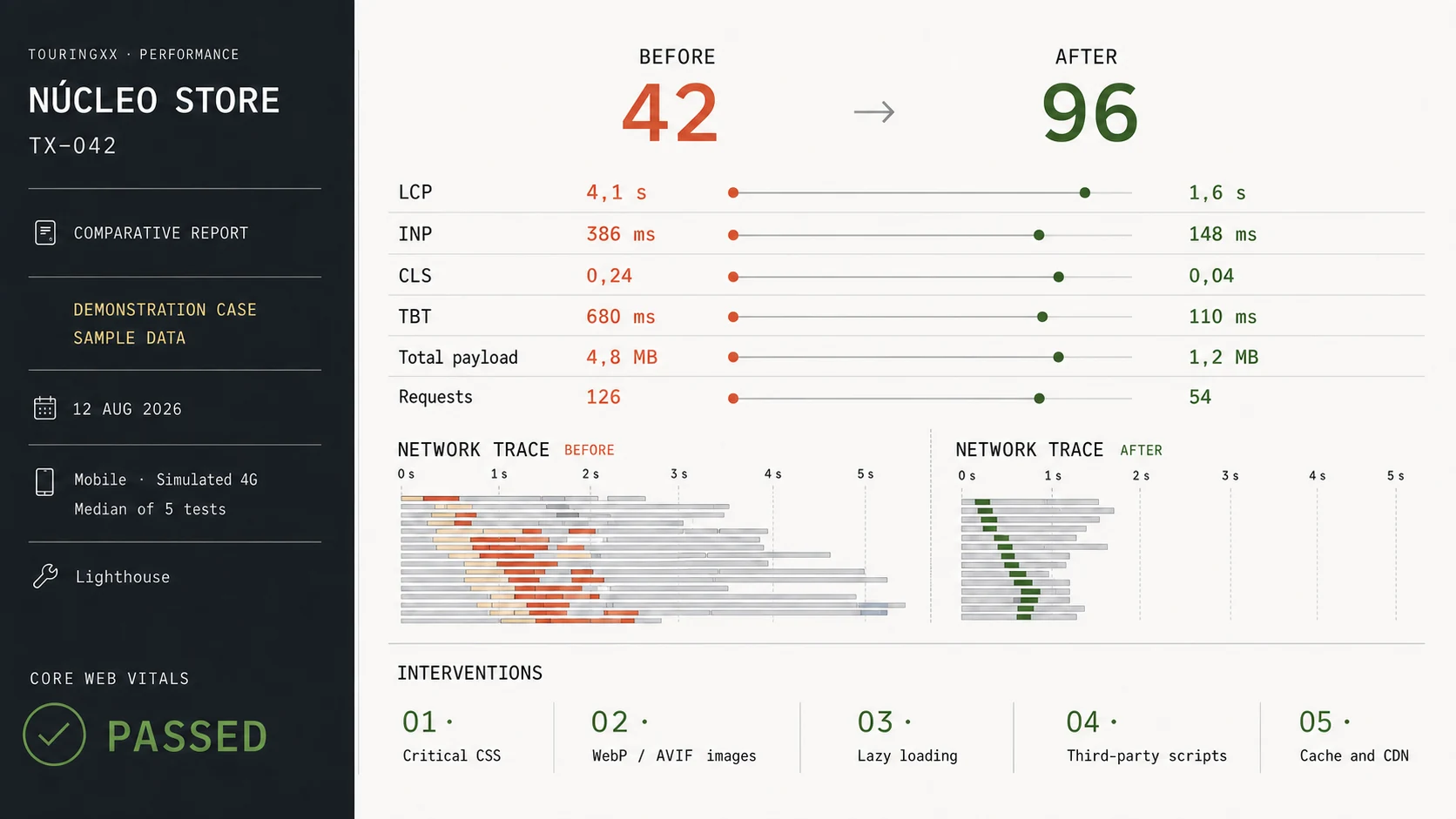
A before-and-after comparison on a real project, with the measurement conditions stated: what was measured, when and with which tool.
“Excellent work! Much faster than I expected, and the site loading speed ended up far better than I would have achieved on my own.”
Original wording · source: Envato Studio
We promise measurement, not a magic number.
We don’t say “your site will load in one second” before seeing it. There are limits imposed by the hosting, the CMS, the third-party scripts the company needs and the site’s own architecture. The audit states what real margin exists and what it would take to go further.
View all testimonialsCommon questions about speed
The audit answers these questions with your site’s data, not with industry averages.
Services that usually go with it
Speed is won once and kept with maintenance.
To go deeper
Why speed affects ranking and conversion.
Let’s start by measuring how your site loads today.
The performance audit delivers the current state, the list of problems ordered by impact and an estimate of what can improve. With that you decide whether optimising is worth it or another route is better.