Let your data move between the tools you already use.
We connect CRM, ERP, invoicing, inventory and e-commerce so repetitive tasks stop being done by hand. Less copying and pasting, fewer transcription errors, and processes that move forward without reminders.
TouringXX’s process automation and integration connects the tools a company already uses so information flows without manual intervention. It is built for teams spending hours copying data between systems, chasing approvals or sending documents repeatedly. The expected outcome is less manual work, fewer transcription errors and processes that advance without relying on reminders.
What it is, concretely
Automating doesn’t mean replacing systems. It means that when something happens — an order arrives, a quote is approved, a status changes — the consequences run on their own: the record is created, the document is generated, the notification goes out and the data stays synchronised everywhere.
The work starts by mapping the real process, not the one in the manual. Manual points, waiting times and data re-entry are identified; from there we decide what is worth automating and what should still go through a person.
Teams that grew faster than their processes.
Signs a process is asking to be automated
What changes when the process stops being manual
Real savings depend on the volume and on how many systems can be integrated. These are the changes the work aims for, measured on the specific process being automated.
Time spent copying and transcribing is freed up for work that needs judgement.
Data is entered once and propagates; there stop being different versions of the same record.
Approvals and follow-ups advance without depending on personal reminders.
CRM, ERP and inventory reflect the same state instead of contradicting each other.
There is a record of what ran, when and with what result.
With data tidy and connected, a query layer on top of it becomes viable.
What gets automated and what gets connected
Automations people ask for most
We map before automating, and measure afterwards.
Automating a poorly understood process multiplies the problem. That is why the first stage is always observing how it works today, with the people who run it.
The real process is observed with the people who run it, recording manual points and waiting times.
Effort and impact are estimated for each point, deciding what to automate first and what stays manual.
Integrations and flows are built, with error handling and alerts when something fails.
Results are compared with the baseline, edge cases are fixed and ongoing monitoring is defined.
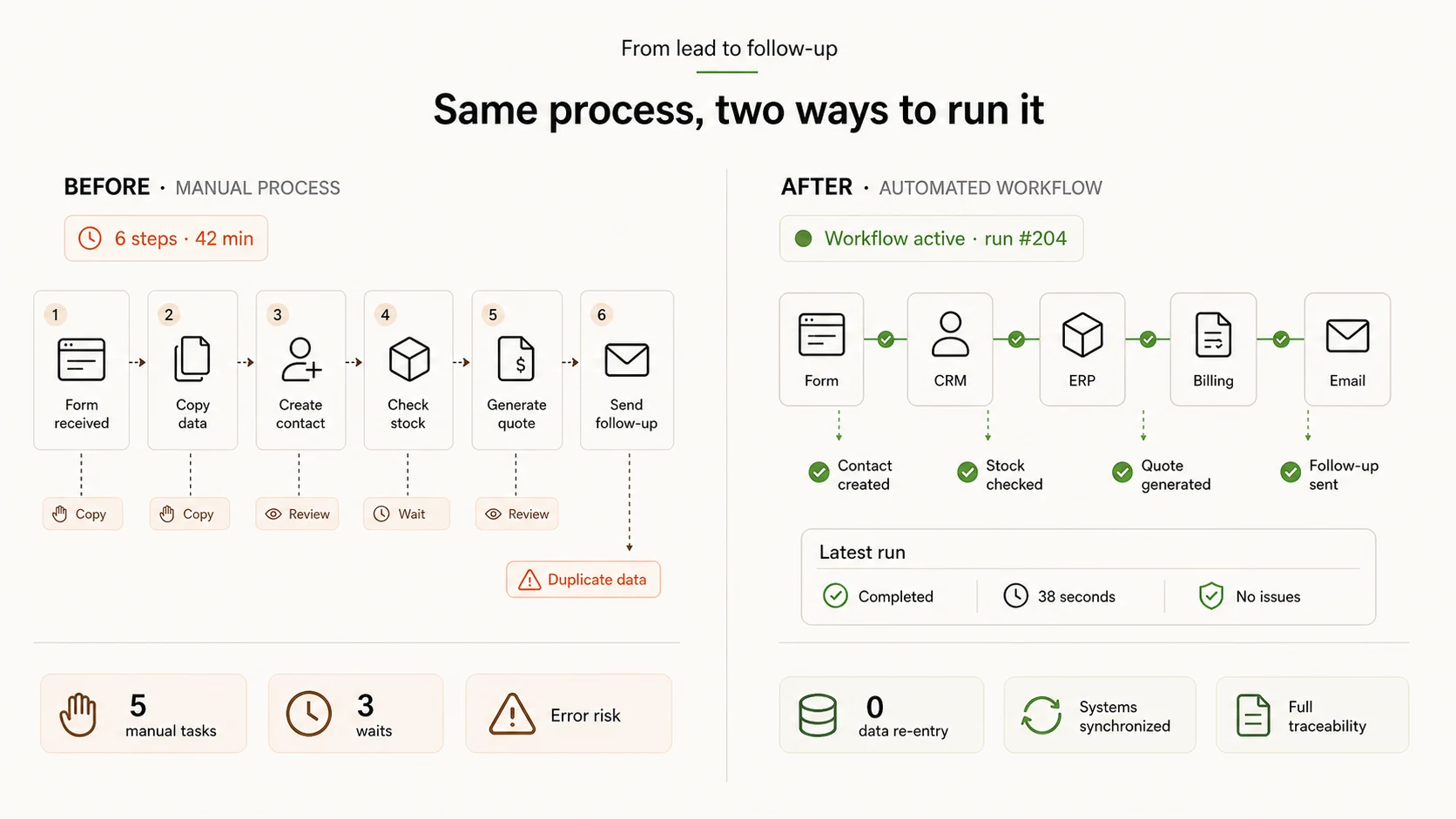
What gets automated is best seen by comparison.
A manual process and the same process automated, side by side: the same steps, with no data re-entry and no waiting between systems.
“They automated approvals and follow-ups. The team stopped copying data between spreadsheets and systems, and things move forward without anyone having to remember them.”
LogiSur · Argentina
Savings are measured on the specific process, not in the abstract.
Before automating, we record how long the current process takes and how often it happens. That baseline is what later allows us to say, with the company’s own data, what changed. Without it, any percentage would be invented.
View all testimonialsCommon questions before automating
If your case isn’t here, the process analysis is where we answer it with your operation in front of us.
Services that usually go with it
Automation is usually the step before or after another piece of work.
To go deeper
How processes are chosen and what to expect from each.
Automations the team can build themselves
AI Hub also offers agents and scheduled tasks for teams that need to centralise several AI capabilities in one platform, on the accounts and services they already have connected.
When the process spans critical systems, requires error handling or depends on bespoke integrations, this service remains the recommended route.
Explore AI HubPick a process that eats time and we’ll analyse it with you.
You don’t need the full map of the operation. One concrete process is enough to estimate the effort, the impact and whether to start there or somewhere else.