Web and product

A store that sells — not just a catalogue online.

We build stores on WooCommerce or custom-developed, with catalogue, checkout and integrations resolved so orders reach your systems complete and customers always know what happened with their purchase.

The journey of an order
1
They find the product
Navigation, search and filters that match how people actually search.
2
They complete checkout
Minimum steps, clear costs and no surprises at the end.
3
Payment is confirmed
An integrated gateway, with states and retries properly resolved.
4
The order enters the system
Stock, invoicing and management update with no manual work.
5
The customer gets updates
Transactional emails with the real shipping status.
Every point of friction in this chain is a sale that doesn’t complete.
At a glance

TouringXX’s e-commerce development builds online stores on WooCommerce or with custom code, covering catalogue, checkout, payments, shipping and integration with management systems. It is built for companies selling online, or about to, that need orders to flow without manual entry. The expected outcome is a store that converts better and doesn’t create admin work every time somebody buys.

Selling online is more than publishing products

A store works when the customer finds what they are looking for, understands what they are buying and completes payment without hesitation. And when, on the other side, that order appears in the system with the right data, updates stock and triggers the right notifications.

The problems are usually in the details: badly organised variations, shipping costs that appear too late, a checkout with too many steps, or stock that doesn’t match reality. That is where the sale is lost — not in the homepage design.

WooCommerce Custom development Multilingual Multi-currency ERP integrations Payment gateways
Who it’s for

Businesses that sell seriously, not occasionally.

Brands with a wide catalogue or with variations. Sizes, colours, formats and combinations that need organising well.
Companies already selling that want to scale. The store works, but growth creates manual work.
Businesses with wholesale and retail. Different prices, terms and catalogues by customer type.
Stores selling to several countries. Languages, currencies, taxes and shipping costs that change by destination.
When another option is better. If you sell a handful of products with no variations and no integrations, a bespoke store may be disproportionate. In that case a simpler solution is the sensible route, and that is what the assessment says.
Common situations

Signs the store is holding sales back

Many customers reach checkout and don’t complete the purchase.
Every order is entered by hand into the management system or a spreadsheet.
Store stock doesn’t match real stock and has to be corrected.
Shipping costs are miscalculated or only appear at the very end.
The store search doesn’t find products that do exist.
Updating prices or publishing a new product takes too long.
Results

What changes with a well-built store

Conversion depends on the product, the price and the traffic, not only on development. What the store can solve is everything that currently loses sales for no reason.

Frictionless checkout

Fewer steps, costs visible from the start and fewer abandonments from confusion.

A catalogue you can navigate

Categories, filters and variations organised around how the customer searches.

Orders that flow on their own

The sale reaches the management system with the right data, with no re-entry.

Reliable stock

What the store shows matches what exists, and it updates on each sale.

Automatic communication

Transactional emails that report real order status and cut enquiries.

A base for growth

A structure that supports more products, more languages and more markets.

Scope

What development covers

Front 01

Catalogue and product

· Category structure · Variations and attributes · Product pages · Search and filters · Prices and promotions
Front 02

Checkout and payments

· Purchase flow · Payment gateways · Shipping calculation · Taxes by region · Coupons and discounts
Front 03

Integrations

· ERP and invoicing · Inventory management · Logistics operators · CRM and marketing · Transactional emails
Front 04

Performance and measurement

· Load speed · Mobile experience · Commerce analytics · Funnel tracking · Product SEO
How we work this service

The catalogue first, the design second.

The catalogue structure — how products, variations and attributes are organised — conditions everything else: navigation, filters, stock and even SEO. Starting there avoids redoing the work.

01 Catalogue

How products, variations, attributes and prices are organised is defined before touching design.

Recibes: agreed catalogue structure
02 Design and flow

Navigation, the product page and checkout are designed with the fewest possible steps.

Recibes: design of the key screens
03 Development and integration

The store is built and payments, shipping, stock and management systems are connected.

Recibes: working store in a test environment
04 Testing and launch

The full purchase journey is tested, fixed and published with active monitoring.

Recibes: store published and measurement configured
A store isn’t finished the day it is published. The first months show where customers abandon, what they look for and don’t find, and which checkout steps are unnecessary. That later tuning usually has more impact on sales than any decision taken before launch.
The purchase experience

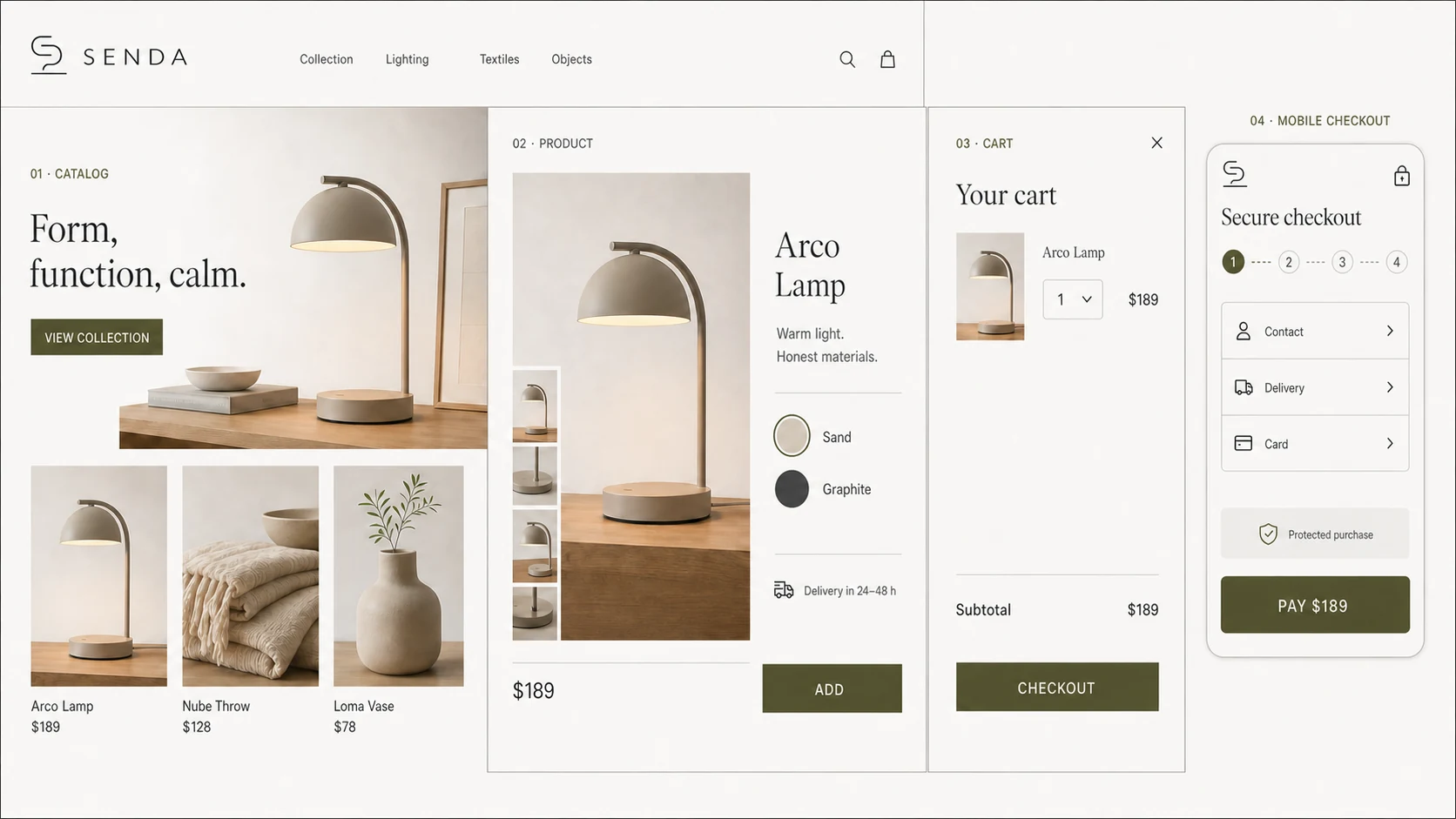
Not a store screen: the full path to payment.

Catalogue, product page, cart and mobile checkout form a single sequence. That is where the sale is won or lost.
Visual pending 16:9
E-commerce experience — catalogue, product page, checkout and mobile view in a single sequence
Service: E-commerce development

“We rebuilt the checkout and connected the store to the management system. Orders come in on their own and we stopped entering every sale by hand.”

▲ No manual order entry
DR
Diego Rossi · CEO
Nodo Estudio · Uruguay
What can be claimed

We can improve the store; we can’t promise sales.

Development removes obstacles: a confusing checkout, a search that finds nothing, shipping that isn’t calculated. How much sales grow also depends on the product, the price, the competition and the traffic. We measure what happens and tune with that data.

View all testimonials
Frequently asked questions

Common questions about online stores

If you already have a store running, it is better to start from a review before deciding whether to rebuild it.

WooCommerce or custom development?+
WooCommerce covers most cases well and allows growth without rebuilding. Custom development makes sense when the sales model is unconventional or requires logic no platform solves. The decision is taken in the assessment, not by preference.
Can you work on our current store?+
Yes. Many projects start from a live store: we review what is worth keeping, what to fix and what to rebuild. Rebuilding everything isn’t always the best decision, and we say so when the case allows.
Does it integrate with our management system?+
It is assessed according to the integration options that system offers: API, exports or existing connectors. If there is no viable route, alternatives are raised before committing to the integration.
What about taxes and international shipping?+
Rules are configured by region according to each market. The fiscal definition comes from the client or their adviser; development implements that configuration, it doesn’t determine it.
Will the store be ready for SEO?+
Catalogue structure, URLs, product structured data and performance are resolved during development. Ranking and content work is a separate service, though it starts from this base.
How long does a store take to build?+
It depends on catalogue size, integrations and whether data has to be migrated. The timeline is estimated when defining scope, after reviewing the catalogue and the systems involved.
What happens after launch?+
Maintenance and a tuning stage with real usage data are recommended. The first months show where customers abandon and what is worth improving; that work usually pays off more than continuing to add features.

Services that usually go with it

A store needs speed, maintenance and someone who answers when something fails.

To go deeper

The most common checkout mistakes and how to avoid them.

Also available in AI Hub

Support, product content and commercial follow-up

AI Hub includes chatbot, shared inbox, CRM and product copy and image generation modules, useful for the team running the store day to day.

The store, its integrations, the checkout and performance are resolved in this service.

Explore AI Hub
Related areas in the platform
08Chatbots, sales and support
09CRM and operations
03Image, design and photography
07Social media and marketing

Tell us what you sell and how orders reach you today.

With the catalogue, the volume and the systems you already use we can define whether a new store, a redesign or fixing specific points of the current one is the right route.