From eight hours a week to one: how we tidied client onboarding at a services company
A process that worked — slow, manual, with errors surfacing two weeks later — turned into a flow with written rules. The interesting part isn’t the tool: it is what had to be decided before touching it.
ClientConfidential client · B2B services companySizeOperations team of fewer than ten peopleServiceAutomation and integrationsDurationAround two and a half monthsTeamTwo people from TouringXX · two from the clientSystemsCRM · invoicing · operations spreadsheet
The case is published as an anonymised study: the client authorised in writing what can be told and what cannot. Some identifying details have been withheld for confidentiality.
In one sentence
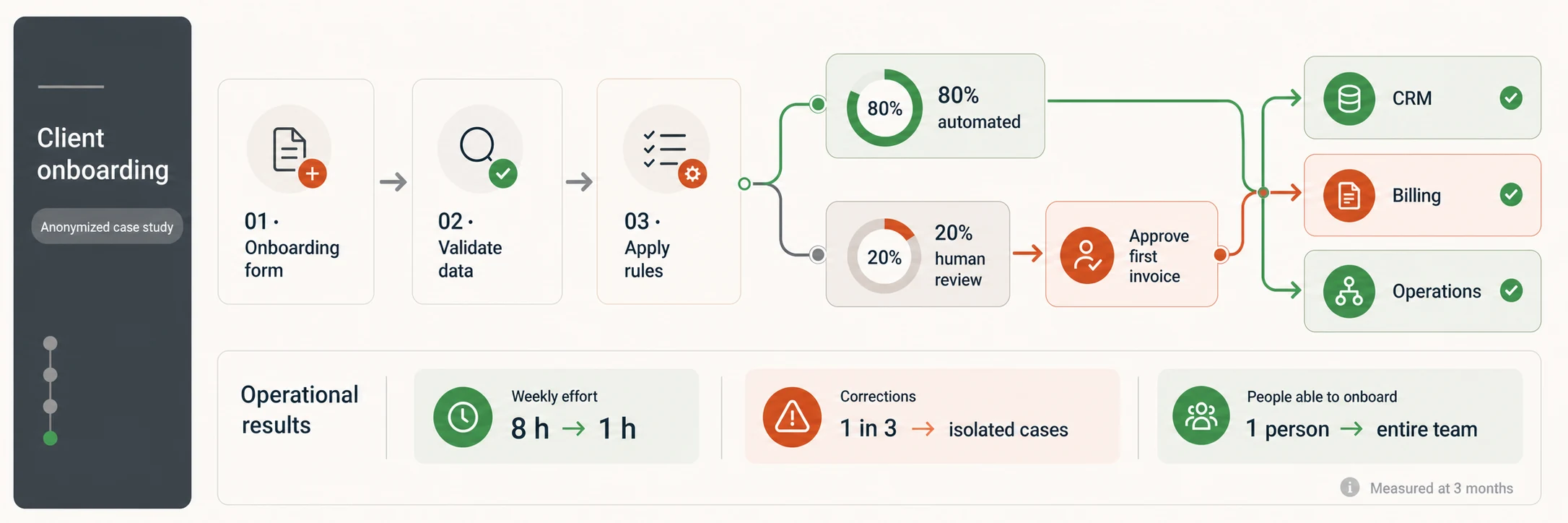
The client onboarded every new customer by hand across three different systems. We wrote down the rules nobody had written, automated 80% of cases and deliberately left the remaining 20% in a person’s hands.
The starting point
The client is a B2B services company with an operations team of fewer than ten people. Every new client onboarding went through three systems — CRM, invoicing and a shared operations spreadsheet — all filled in by hand by the same person. It worked: the problem wasn’t that it failed, it was what it cost to sustain.
Eight hours a week from one person
Copying the same data into three places, chasing missing documents and answering follow-up emails. None of it required judgement.
Errors that surfaced two weeks later
A mistyped detail in invoicing went unnoticed until the first payment run. Fixing it cost more than doing it right, and always fell to somebody else.
Everything depended on that person being there
On holiday, onboardings piled up. There was no manual: there was memory.
What had to be solved before automating anything
The first meeting wasn’t about tools. It was about why two people onboarded the same kind of client differently, with neither of them wrong: each had learned from a different manager. That was the real project.
We were asked to automate a process. The first thing we delivered was the process written down, which didn’t exist. Without that, any automation would have set one person’s version in stone.
Project lead at TouringXX
How we did it
Four phases across about two and a half months. The first two didn’t touch a single line of code.
Phase 1
Two weeks
Writing down the process that didn’t exist
We sat down the two people who handled onboarding and documented every decision they made, including the ones that contradicted each other. Out came fourteen rules and five cases where nobody knew which was right.
Deliverable: process document approved by operations
Phase 2
One week
Resolving the contradictions
The five open questions went up to management, which decided. It is the most uncomfortable phase and the one that saves the most time later: without it, the automation would have frozen an arbitrary version.
Deliverable: final rules, signed off
Phase 3
Three weeks
Building the flow
Onboarding form, validations, creation across the three systems and notifications to whoever needs them. This is where the integration problem appeared: one field couldn’t be written to.
Deliverable: Flow in production with an action log
Phase 4
Four weeks
Support and adjust
Four weeks reviewing every onboarding with the team, correcting what the written process hadn’t anticipated. They decided themselves when to stop reviewing.
Deliverable: Operations manual and handover
Three decisions that changed the outcome
This is the part that usually goes untold, and the only one reusable on another project.
Leaving 20% of cases outside the automation
Clients with special terms are still onboarded by hand. They are few, they change often, and automating them would have cost more than all the rest together.
Alternative ruled out: Cover 100% of cases. Ruled out: it would have tripled the duration to automate something that happens twice a month.
Not changing CRM
The one they had wasn’t the best, but it worked and the team knew it. Migrating would have turned a process project into a systems project.
Alternative ruled out: Migrate to a platform that integrated everything out of the box. Ruled out: the saving didn’t justify the risk or the learning time.
Human confirmation before invoicing
The flow prepares everything and stops before issuing. A system that could invoice without review isn’t a saving: it is a risk with a friendly interface.
Alternative ruled out: Fully automatic issuing. Ruled out by the client, and we agreed.
What changed
Measured on the same process, with the same criteria, before and at three months. These are operational figures — time and errors — not business ones: a company’s growth depends on its market, its product and its team, and attributing it to a project of ours would be dishonest.
Weekly time spent
BeforeAround 8 hours from one person, timed over 5 real onboardings.
At three monthsClose to 1 hour, measured the same way on the same kind of cases.
Onboardings needing later correction
BeforeRoughly one in three, caught late.
At three monthsIsolated cases, caught at the point of entry by the validations.
People able to complete an onboarding
Before1, with a second partly trained.
At three monthsThe whole operations team, following the manual.
Measurement carried out by the client with their own records. We didn’t touch the figure.
What didn’t go as expected
Phase 3 ran about two weeks long because one of the integrations wouldn’t allow writing to the field we needed and the approach had to change halfway. It wasn’t the client’s fault, nor a surprise more analysis would have avoided: it was discovered on trying. We tell it because a case where everything goes right first time helps nobody plan their own.
In the client’s words
“What we asked for was an automation. What we got first was our own process written down, which we didn’t have. That was the uncomfortable part, and the one that made the rest work.”
CC
Head of operations
Confidential client
Does your process look like this one?
Tell us how it works today, exceptions included. We’ll say whether it can be automated, what it would take, and when the honest answer is that it has to be written down first.
We use technologies that are necessary for the site to work and, with your permission, analytics to understand how it is used and improve the experience.