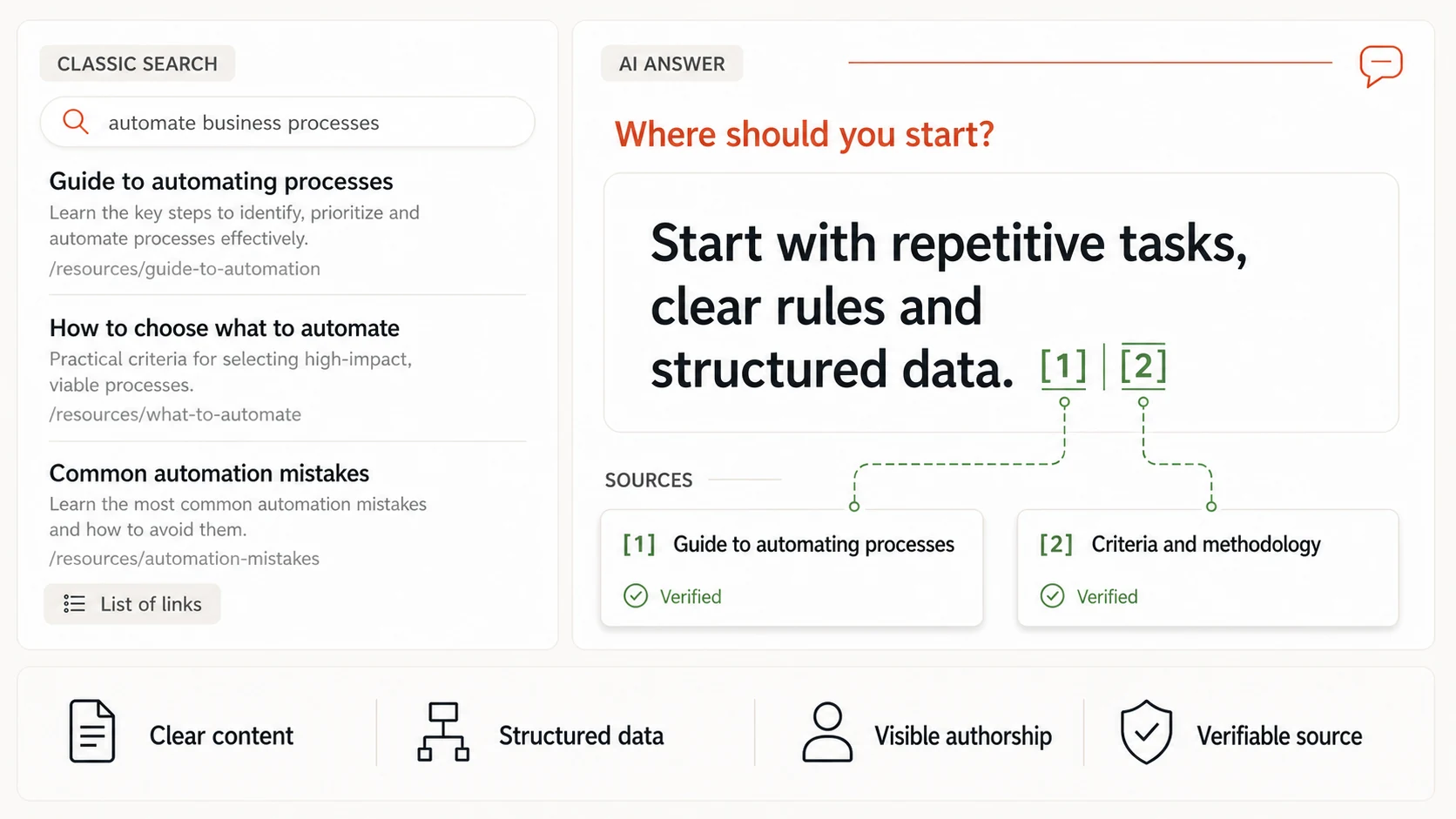
Put the answer in a self-contained fragment at the top of the page, sign it with a visible author and dates, declare your sources, and make sure your service page and your article don’t contradict each other. A model cites what it can read, verify and attribute — not what ranks first.
For a model to cite you it needs three things: to find the answer in a short, self-contained fragment; to be able to attribute it to an identifiable source — author, date, organisation; and to find no contradictions between that page and the rest of your site. Structure weighs more than length, and coherence across pages weighs more than any keyword.
The question comes from marketing and usually arrives with a screenshot: someone asked an AI assistant about their sector, the answer cited three competitors and they weren’t there. The first reaction is to assume it is a ranking problem. It almost never is.
Why does a model cite some pages and not others?
Because it needs to extract a specific claim and be able to support it. Four factors explain most of the cases we have seen.
The answer sits in a self-contained fragment
A paragraph that makes sense without having read the previous five. If the answer is spread across three sections it cannot be extracted without rewriting it — and then another source is preferred.
The source is attributable
A named author, publication and review dates, an identifiable organisation. A page with no byline and no date is a page the model cannot defend if asked where it came from.
There are no internal contradictions
If your service page says one thing and the article says another, the model detects the conflict and avoids both. Coherence across pages is a trust factor.
The claim is verifiable elsewhere
Claims that match other sources get cited more. Own figures with no stated methodology are cited rarely, and with reservations.
What changes compared to classic SEO?
Less than is said and more than is assumed. The technical side is unchanged — if it can’t be crawled, it doesn’t exist; what changes is what gets rewarded inside the page.
The competing unit
Classic SEO
The whole page, against other pages.
Visibility in AI answers
The fragment, against fragments from any site.
What it rewards
Classic SEO
Domain authority, links, search intent.
Visibility in AI answers
Clarity of the claim, attribution and absence of contradictions.
Length
Classic SEO
Long texts tend to perform better.
Visibility in AI answers
Indifferent: what matters is that the answer is up top and isolated.
How it is measured
Classic SEO
Positions, clicks and impressions in Search Console.
Visibility in AI answers
Mentions and citations in generated answers: it has to be measured separately.
Left column: Classic SEO. Right column: Visibility in AI answers.
How should a page be structured to get cited?
With the same pattern we use in this Insights section, which is no coincidence: every article is a demonstration of the method we sell.
1
The answer, in the first block
Before the introduction, in two or three complete sentences that stand alone. That is the fragment the model will extract.
2
Subheads written as questions
Your clients’ real questions, written the way they would say them. Each section answers one, and only one.
3
Author, publication and review dates, visible
Not in the footer or in a metadata field: in the header, where it is read. Without this, the page is not attributable.
4
Sources and assumptions declared
Where each figure comes from and in what context it was measured. If it is own experience, say so — it is a valid source when declared.
5
Markup that confirms what the text already says
Article, FAQPage, Person, dates. Markup adds nothing the text doesn’t say: it only makes it unambiguous.
If your best answer sits eight minutes into a two-thousand-word piece, for a model it may as well not exist.
A rule we apply when rewriting pages for visibility.
How do you measure something Search Console doesn’t show?
There is no official metric, so you build one. It is more manual than anyone would like, but it is measurable and repeatable.
A fixed list of real questions
Between twenty and forty, the ones a client would use before hiring. They are frozen: if the list changes every month there is no comparable series.
Periodic queries in the assistants your audience uses
Same day of the month, same questions; you record whether you appear cited, mentioned without a link, or absent.
Referral traffic from assistants
It can be isolated in analytics. It is low volume and usually converts better than average: people arriving with the answer already, looking for the provider.
What to do next
Four things you can check on your site today
Do your service pages answer the main question in the first paragraph?
Is there a visible author and date on the content?
Does your article say the same as your service page?
Have you written down the twenty questions a client would ask?
· Own observation across studio projects with mention tracking.· Public search engine documentation on structured data and generated content.· No citation percentages included: they depend on the sector and change every few months.
Use of AI, and history
Model-assisted research — including queries to assistants to observe how they cite — with human criteria, examples and final review. Signed: the TouringXX editorial team, with the people who worked on the projects cited.
History: v1.1 — the comparison with classic SEO was rewritten, having overstated the differences.
Want to know whether you’re cited today — and who shows up instead?
Write to us with three questions a client in your sector would ask. We’ll send back what the assistants answer and which sources they cite. It is an indicative review of the questions you send, not a full audit: the specific scope is agreed before starting.
We use technologies that are necessary for the site to work and, with your permission, analytics to understand how it is used and improve the experience.